
AI Observability: Why Monitoring AI Systems Is the Next Big Enterprise Challenge
AI Observability: Why Monitoring AI Systems Is the Next Big Enterprise Challenge
Introduction
Artificial Intelligence has rapidly evolved from experimental projects into business-critical systems.
Organizations now rely on AI to assist customers, automate operations, analyze data, generate content, and improve decision-making.
However, deploying an AI model is only the beginning.
Unlike traditional software, AI systems continuously interact with changing data, evolving user behavior, and external knowledge sources.
Without proper monitoring, businesses may face issues such as:
- Incorrect responses
- Hallucinations
- Rising operational costs
- Slow response times
- Model drift
- Security risks
- Compliance challenges
This is where AI Observability becomes essential.
AI observability helps organizations understand how their AI systems behave, why they make certain decisions, and how their performance changes over time.
What is AI Observability?
AI Observability is the practice of continuously monitoring, measuring, and improving AI applications throughout their lifecycle.
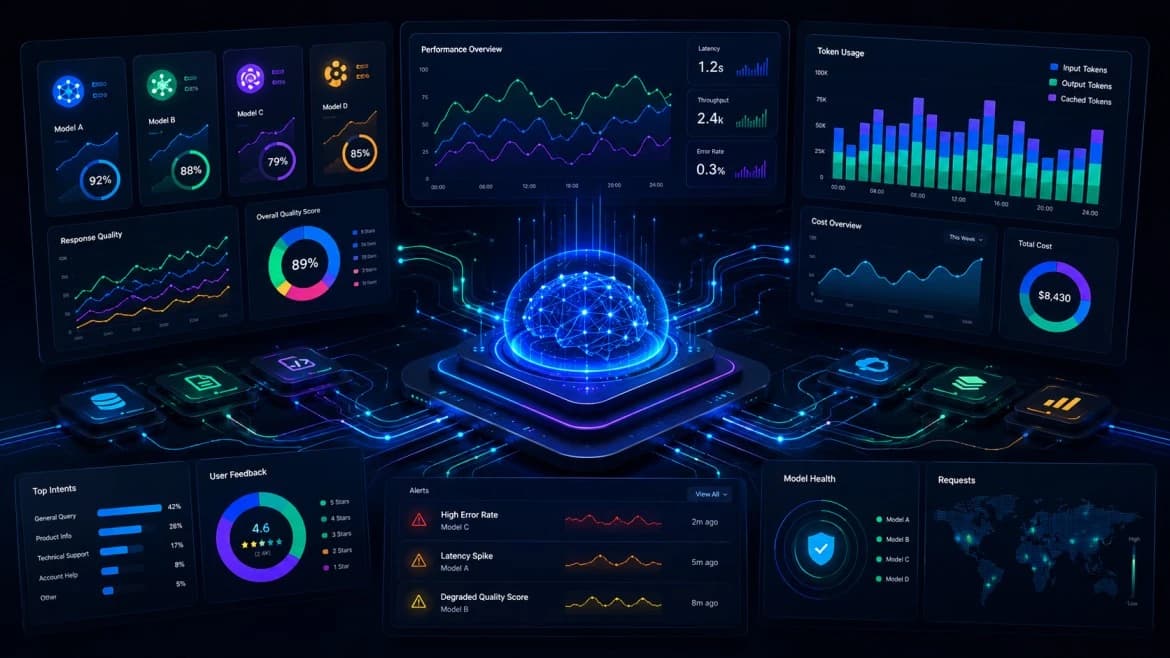
Rather than only checking whether an application is online, AI observability provides visibility into:
- Model performance
- Prompt quality
- Response accuracy
- Latency
- Token usage
- API failures
- Hallucination rates
- User feedback
- Cost per request
It allows engineering teams to identify problems before they impact customers.
Why Traditional Monitoring Is Not Enough
Conventional application monitoring focuses on metrics such as:
- CPU usage
- Memory consumption
- Network traffic
- API availability
While these remain important, they cannot answer AI-specific questions such as:
- Why did the model generate an incorrect response?
- Which prompt caused the failure?
- Has response quality declined?
- Is the model hallucinating?
- Why has token usage increased?
AI systems require a deeper layer of observability.
Key Components of AI Observability
Prompt Monitoring
Organizations track how prompts evolve over time and identify which prompt versions produce the best responses.
Response Quality
Monitoring response accuracy helps detect hallucinations and unreliable outputs before they affect users.
Model Performance
Engineering teams measure:
- Response time
- Throughput
- Error rates
- Availability
to maintain consistent performance.
Token Consumption
Large Language Models often charge based on token usage.
Observability helps businesses optimize prompts and reduce unnecessary costs.
User Feedback
Collecting user ratings and interactions provides valuable insights into AI performance and customer satisfaction.
Compliance and Security
Sensitive industries require visibility into how AI handles confidential information.
Observability supports governance and regulatory compliance.
Real-World Applications
Customer Support
Monitor answer quality, escalation rates, and customer satisfaction.
AI Agents
Track tool usage, workflow execution, reasoning paths, and success rates.
Enterprise Search
Measure retrieval quality, document relevance, and search performance.
Healthcare
Ensure AI recommendations remain accurate, explainable, and compliant.
Financial Services
Detect abnormal responses while maintaining regulatory standards.
Benefits for Businesses
Implementing AI observability helps organizations:
- Improve customer experience
- Detect hallucinations early
- Reduce AI operating costs
- Increase reliability
- Strengthen governance
- Optimize prompts
- Improve model performance
- Build trust in AI systems
AI Observability and MLOps
Modern AI development increasingly combines:
- MLOps
- DevOps
- AI Observability
- Prompt Engineering
- Model Evaluation
Together, these practices create a complete lifecycle for enterprise AI.
Building a model is no longer enough.
Organizations must continuously monitor and improve it.
Future Trends
As AI adoption continues to grow, observability platforms are expected to become a standard part of enterprise AI infrastructure.
Future capabilities may include:
- Automatic hallucination detection
- AI quality scoring
- Cost optimization dashboards
- Prompt analytics
- Security monitoring
- Regulatory reporting
- Multi-agent monitoring
Organizations investing in observability today will be better prepared for the next generation of AI applications.
Conclusion
Artificial Intelligence is becoming a core business capability, but reliability cannot be assumed.
AI systems require continuous monitoring to remain accurate, secure, and cost-effective.
AI observability provides the visibility organizations need to understand, improve, and trust their AI applications.
As businesses move toward intelligent automation and AI-powered decision-making, observability will become just as important as the AI models themselves.
Frequently Asked Questions
What is AI Observability?
AI observability is the process of monitoring AI systems to ensure they remain accurate, reliable, secure, and cost-efficient.
Why is AI observability important?
It helps detect hallucinations, monitor costs, improve model quality, and maintain enterprise reliability.
Is AI observability different from application monitoring?
Yes. Traditional monitoring focuses on infrastructure, while AI observability tracks AI-specific metrics such as prompt quality, response accuracy, and token usage.
Which businesses need AI observability?
Any organization deploying AI chatbots, AI agents, enterprise search, recommendation systems, or generative AI applications can benefit.
What is the future of AI observability?
As AI adoption grows, observability is expected to become a standard component of enterprise AI platforms.
About MYWE Technologies
MYWE Technologies a leading Software company in Thrissur,kerala, helps organizations design, deploy, and optimize intelligent AI solutions through enterprise software development, AI integration, cloud technologies, automation, and digital transformation.
Our goal is to build secure, scalable, and reliable AI systems that deliver measurable business value.
Related Articles
 Artificial Intelligence
Edge AI vs Cloud AI: Choosing the Right AI Strategy for Your Business
 Artificial Intelligence
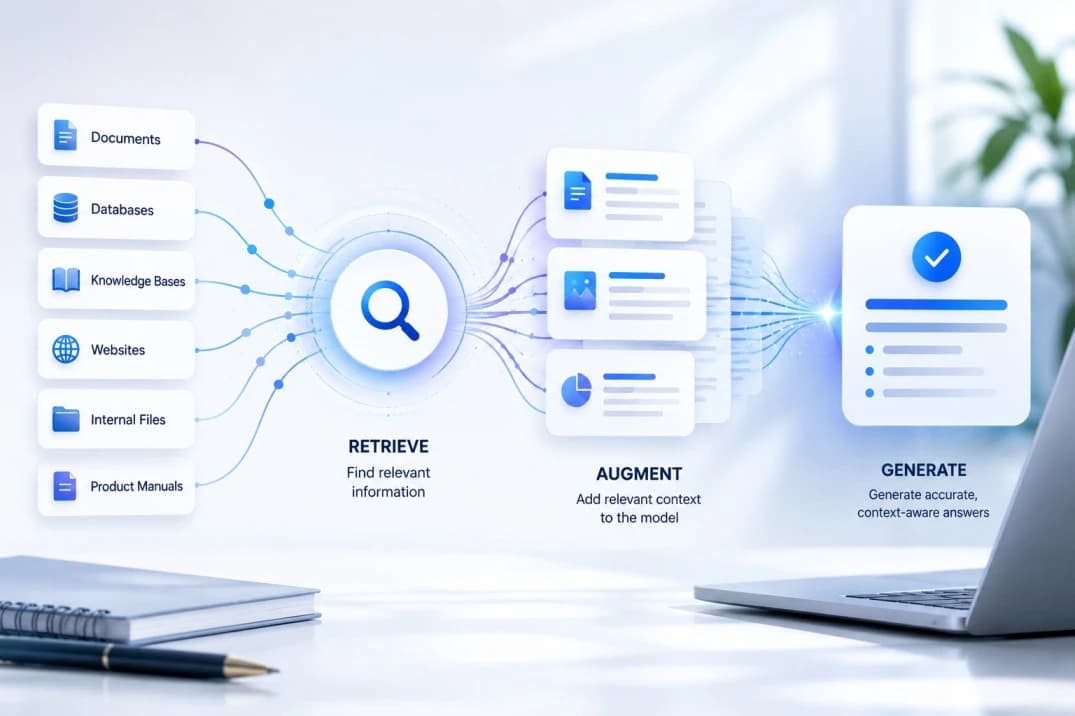
Retrieval-Augmented Generation (RAG): Why AI Needs Context to Deliver Better Answers
 Artificial Intelligence