Retrieval-Augmented Generation (RAG): Why AI Needs Context to Deliver Better Answers
Retrieval-Augmented Generation (RAG): Why AI Needs Context to Deliver Better Answers
Introduction
Large Language Models have transformed the way businesses interact with information.
They can summarize documents, write code, answer questions, and assist with research.
However, despite their impressive capabilities, traditional AI models have an important limitation.
They only know what they were trained on.
They do not automatically understand your company's documents, policies, databases, or latest business information.
This is where Retrieval-Augmented Generation, commonly known as RAG, becomes important.
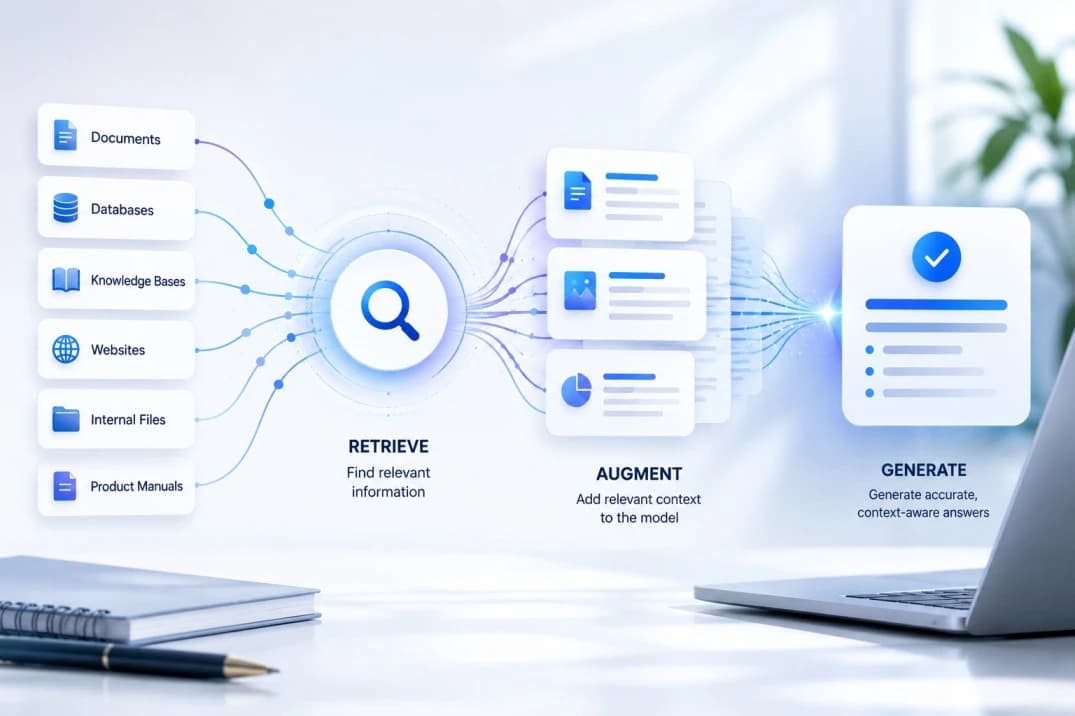
RAG enables AI systems to retrieve relevant information from external sources before generating responses.
Instead of relying entirely on training data, AI becomes context-aware and significantly more useful for real-world business applications.
What is Retrieval-Augmented Generation (RAG)?
Retrieval-Augmented Generation is an AI architecture that combines:
- Large Language Models (LLMs)
- External knowledge sources
- Information retrieval systems
Before generating an answer, the AI retrieves relevant information from trusted sources such as:
- Documents
- Databases
- Knowledge bases
- Websites
- Internal company files
- Product manuals
The retrieved information becomes context for the model, resulting in more accurate and up-to-date responses.
Why Traditional AI Models Need Context
Without external context, AI systems can:
- Produce outdated answers
- Hallucinate information
- Miss company-specific details
- Lack access to recent events
For example, an AI assistant trained months ago may not know:
- Your latest pricing
- Internal procedures
- New policies
- Product documentation
- Customer records
RAG solves this problem by retrieving current information before generating responses.
How RAG Works
A typical RAG architecture consists of:
Knowledge Source
Documents, PDFs, databases, and websites.
Embedding Model
Converts information into vectors.
Vector Database
Stores and indexes embeddings for efficient retrieval.
Retriever
Finds relevant information based on user queries.
Language Model
Uses retrieved context to generate answers.
Together, these components enable AI systems to provide reliable and context-aware responses.
Real-World Applications
Customer Support
AI assistants can search:
- FAQs
- Product manuals
- Knowledge bases
to answer customer questions accurately.
Enterprise Search
Employees can instantly search:
- Policies
- Documents
- Internal wikis
- Technical guides
without manually browsing folders.
Healthcare
AI systems can retrieve:
- Medical literature
- Treatment protocols
- Patient information
to support healthcare professionals.
Software Development
Developers can use AI to search:
- Documentation
- APIs
- Repositories
- Technical specifications
for faster development.
Legal and Compliance
RAG systems help organizations retrieve:
- Contracts
- Policies
- Regulations
to improve decision-making.
Why Businesses Are Adopting RAG
Improved Accuracy
Responses are based on trusted information sources.
Reduced Hallucinations
Retrieval minimizes incorrect or fabricated answers.
Access to Real-Time Information
Businesses can provide up-to-date responses.
Better Enterprise AI
Organizations can securely use their own knowledge.
Scalability
RAG systems can work with millions of documents.
RAG vs Fine-Tuning
Many people confuse RAG with fine-tuning.
Fine-Tuning
Updates model behavior through additional training.
Advantages
- Specialized responses
- Consistent style
Limitations
- Expensive
- Time-consuming
- Difficult to update
RAG
Retrieves information dynamically.
Advantages
- Real-time knowledge
- Easier maintenance
- Lower costs
- Better scalability
For many enterprise applications, RAG is often a more practical solution.
RAG and AI Agents
Modern AI agents become much more powerful when combined with RAG.
Agents can:
- Search documentation
- Access internal knowledge
- Retrieve information
- Generate context-aware responses
Together, RAG and AI Agents enable intelligent digital assistants capable of performing real work.
Future Trends
The future of AI will increasingly combine:
- AI Agents
- MCP Servers
- Vector Databases
- RAG Architectures
- Tool Calling
- Multi-Agent Systems
These technologies are creating AI systems that are more intelligent, reliable, and useful.
Conclusion
Large Language Models are powerful, but knowledge without context has limitations.
Retrieval-Augmented Generation bridges that gap by allowing AI systems to access external information before generating responses.
As organizations adopt AI across support, analytics, knowledge management, and automation, RAG is becoming one of the foundational technologies powering enterprise AI.
The future of AI is not just about bigger models.
It's about smarter systems that understand context.
Frequently Asked Questions
What is RAG in AI?
RAG stands for Retrieval-Augmented Generation. It combines language models with external knowledge sources to improve response accuracy.
Why is RAG important?
RAG enables AI systems to provide current, reliable, and context-aware responses.
Does RAG replace fine-tuning?
Not necessarily. Both approaches have different use cases and are often used together.
What industries can benefit from RAG?
Healthcare, finance, legal, customer support, software development, education, and enterprise knowledge management.
Why is RAG becoming popular?
Because businesses need AI systems that can work with their own documents and up-to-date information.
About MYWE Technologies
MYWE Technologies helps businesses adopt emerging AI technologies including AI Agents, Retrieval-Augmented Generation (RAG), intelligent automation, custom software development, and digital transformation solutions.
We believe the future belongs to AI systems that are connected, contextual, and capable of delivering real business value.