
Model Context Protocol (MCP): The Missing Layer That Makes AI Agents Truly Useful
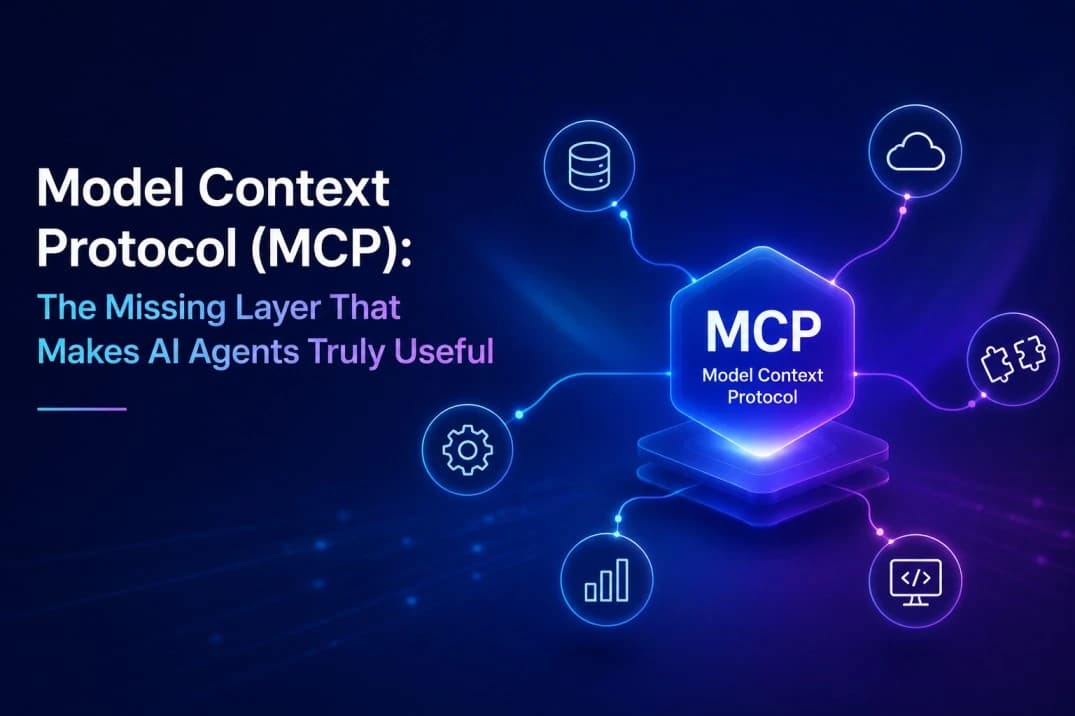
Model Context Protocol (MCP): The Missing Layer That Makes AI Agents Truly Useful
Introduction
Large Language Models have transformed how businesses interact with information.
Modern AI systems can summarize documents, answer questions, write code, and assist with research.
However, traditional AI models have one major limitation.
They can reason about information, but they cannot naturally interact with external systems.
They cannot directly:
- Access databases
- Use internal tools
- Connect to APIs
- Execute workflows
- Retrieve live information
- Interact with software applications
This is where Model Context Protocol (MCP) comes into the picture.
MCP is emerging as one of the most important technologies powering the next generation of AI agents.
What is Model Context Protocol (MCP)?
Model Context Protocol, commonly called MCP, is an open standard that allows AI models to communicate with external systems and tools.
Think of MCP as a USB-C port for AI.
Instead of building custom integrations for every application, MCP provides a standardized way for AI systems to connect with:
- APIs
- Databases
- CRMs
- Documentation
- Business applications
- Plugins
- Internal knowledge bases
This enables AI agents to move beyond conversation and actually perform useful work.
Why Traditional AI Models Need MCP
Without external context, AI models are limited.
For example, an AI assistant cannot:
- Access your CRM
- Retrieve customer information
- Query inventory databases
- Search internal documents
- Trigger workflows
MCP solves this problem by giving AI agents structured access to external resources.
This turns AI from a chatbot into a digital coworker.
How MCP Works
An MCP architecture typically consists of:
AI Model
Responsible for reasoning and generating responses.
MCP Client
Acts as an intermediary between the model and available tools.
MCP Server
Exposes resources and capabilities.
External Systems
Such as:
- GitHub
- Slack
- PostgreSQL
- Google Drive
- Notion
- Internal APIs
- Enterprise applications
The AI agent can discover available capabilities and use them when necessary.
Why MCP Matters
MCP creates a common language between AI and software systems.
Instead of developing separate integrations for every AI platform, developers can build once and expose capabilities through MCP.
This provides:
- Better interoperability
- Faster development
- Easier maintenance
- Greater scalability
Real-World Examples
Development Teams
AI agents can:
- Access GitHub repositories
- Search documentation
- Analyze codebases
- Create pull requests
Customer Support
AI assistants can:
- Access CRM records
- Retrieve customer history
- Generate responses
- Escalate tickets
Analytics
AI systems can:
- Query databases
- Analyze metrics
- Generate reports
- Explain trends
Internal Knowledge Systems
AI agents can:
- Search documentation
- Retrieve company policies
- Answer employee questions
MCP and Plugins
Plugins were an important step in AI evolution.
However, plugins often required platform-specific integrations.
MCP provides a more universal approach.
Instead of creating separate plugins for every ecosystem, developers can expose capabilities through a standard interface.
This improves portability and reduces complexity.
MCP and AI Agents
AI agents become significantly more powerful when combined with MCP.
Agents can:
- Understand goals
- Access external information
- Use tools
- Execute workflows
- Coordinate multiple systems
This enables autonomous and intelligent operations.
Future Applications
Over the next few years, MCP-powered agents may help businesses:
- Automate operations
- Generate reports
- Manage customer interactions
- Coordinate workflows
- Assist software development
- Improve knowledge management
The possibilities are enormous.
Conclusion
Model Context Protocol represents a major step toward practical AI systems.
Instead of isolated chatbots, businesses are moving toward intelligent agents capable of interacting with tools, applications, and knowledge sources.
As AI continues to evolve, standards like MCP will play a critical role in making AI systems more connected, useful, and scalable.
Organizations that understand these technologies early will be better positioned to take advantage of the next wave of AI innovation.
Frequently Asked Questions
What is MCP?
Model Context Protocol is an open standard that enables AI models to communicate with external systems, APIs, databases, and tools.
Why is MCP important?
MCP makes AI agents more useful by allowing them to interact with real-world systems rather than operating only on static information.
Is MCP replacing plugins?
Not exactly. MCP provides a more standardized and interoperable approach compared to platform-specific plugins.
Who can benefit from MCP?
Developers, enterprises, AI startups, and organizations building AI-powered applications can all benefit from MCP.
Is MCP open source?
Yes, MCP is an open standard designed to improve interoperability across AI ecosystems.
About MYWE Technologies
MYWE Technologies a leading software company in Thrissur, helps organizations leverage emerging technologies including AI agents, intelligent automation, custom software development, and digital transformation solutions.
We believe the future belongs to AI systems that are connected, contextual, and capable of delivering real business value.
Related Articles
 Artificial Intelligence
AI Observability: Why Monitoring AI Systems Is the Next Big Enterprise Challenge
 Artificial Intelligence
Edge AI vs Cloud AI: Choosing the Right AI Strategy for Your Business
 Artificial Intelligence